Wednesday, February 9, 2011
Winter twig photos
I found some winter twig photos at http://spicebush.blogspot.com/2011/01/quiz-3-answers.html.

Trees by the library
Today on lunch hour, I observed two types of trees by the library. All were small. Sometimes one doesn't know whether trees are small because they are young, or because it is their nature -- maybe they are shrubs, or a type of tree that just doesn't get much bigger.
The trees along the side of the library had peeling white bark, so I figured they were birch. Well, it wasn't a snow-white color, like the trees I noticed the other day. It was more red or yellow or rust. The trees were the same shape as the birches I observed the other day -- one sapling-size twig, and lots of twig-size branches. While much of the trunk bark was whitish, the branches and some of the trunk were darker, in kind of a red-gray way.

Some were all dark, without the white:
At first I had thought the outer bark was whitish, and the darker color was where all the white had peeled away. But when I looked closer, it seemed the darker color was the outer bark, and the white was inside, where it had peeled back.

The two trees behind the library were short and stubby. Shorter than the birches, but with wider, fuller branching. I thought they might be beeches I had heard that the other trees besides oaks that have brown leaves in winter are beeches. The twigs forked at the end, with end buds at the ends of each fork. The buds were puffy, then pointed, like in Russian architecture.

I looked for side buds but did not see any. The bark was mostly gray, but on one of the trees, there was a patch on the trunk that had peeled off to reveal reddish bark below.

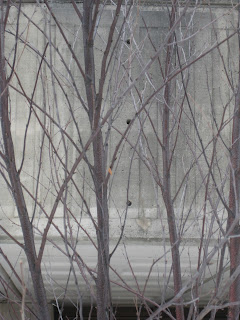
When I got home and checked my book, naturally what I saw did not match anything in the book. There was a bush called hobblebush with the twigs that fork at the end, but the hobblebush buds were a different shape, and I read that hobblebush branches reach out more horizontally. However this picture that I took of the same tree or bush looks a little more like the pictures of hobblebush that I found on the internet:
The trees along the side of the library had peeling white bark, so I figured they were birch. Well, it wasn't a snow-white color, like the trees I noticed the other day. It was more red or yellow or rust. The trees were the same shape as the birches I observed the other day -- one sapling-size twig, and lots of twig-size branches. While much of the trunk bark was whitish, the branches and some of the trunk were darker, in kind of a red-gray way.

Some were all dark, without the white:

At first I had thought the outer bark was whitish, and the darker color was where all the white had peeled away. But when I looked closer, it seemed the darker color was the outer bark, and the white was inside, where it had peeled back.

The two trees behind the library were short and stubby. Shorter than the birches, but with wider, fuller branching. I thought they might be beeches I had heard that the other trees besides oaks that have brown leaves in winter are beeches. The twigs forked at the end, with end buds at the ends of each fork. The buds were puffy, then pointed, like in Russian architecture.

I looked for side buds but did not see any. The bark was mostly gray, but on one of the trees, there was a patch on the trunk that had peeled off to reveal reddish bark below.

When I got home and checked my book, naturally what I saw did not match anything in the book. There was a bush called hobblebush with the twigs that fork at the end, but the hobblebush buds were a different shape, and I read that hobblebush branches reach out more horizontally. However this picture that I took of the same tree or bush looks a little more like the pictures of hobblebush that I found on the internet:
Sunday, January 30, 2011
Some questions raised by today's nature walk
Today I noticed a tree that had snow on the branches, similar to the trees I photographed January 8, after a recent snowfall. Now, snowfall is not so recent, and most of the trees no longer have snow on the branches. The one that did seemed to be in a somewhat sheltered spot, near a house and some other trees. Seeing it made me wonder, what is it that causes the snow to stop being on the branches of trees? Does the sun melt the snow? Or does the wind blow it off? Or is it both?
Today's walk lasted about an hour, the last hour before sunset. I noticed the trees silhouetted against the sky. What is it about winter dusk that draws our attention to trees silhouetted against the sky? Are trees not against the sky in summer and in daylight?
Today's walk lasted about an hour, the last hour before sunset. I noticed the trees silhouetted against the sky. What is it about winter dusk that draws our attention to trees silhouetted against the sky? Are trees not against the sky in summer and in daylight?
My first exploration of winter twigs
I have been reading about identifying trees in winter by their twigs in A Guide to Nature in Winter by Donald Stokes, so I decided to go out today to look at winter twigs and see what I could see.
The book made it sound easy. For each type of tree, two characteristics of the twigs are given, and that's enough to identify the type of tree (the book identifies them by genus, not species). I knew from my experience with summer identification that it's never as easy as it sounds. I also had noticed that the book did not include all the kinds of trees that I know are in my neighborhood. Thus to make things easy, I started off my examining some trees I already knew from my summer identification.
First I looked at ash trees. I could not see the twigs very well because the branches were too high. I had binoculars (a Christmas gift from my brother and his wife) so I used those to get a look at the twigs. I did see that they had opposite side buds and end buds. The book says that the way to tell ash and maple apart in winter is by their end buds, but either I couldn't get a good look at the end bud, or else I just didn't know what to look for, since I did not recall at that time what the book said about telling ash apart from maple. Also, in a residential neighborhood, I was a little uncomfortable about using the binoculars too much, for fear someone would think I was spying on them.
Next I looked at Norway maple twigs. This was easier because the tree was on a hill. By standing in a spot that was higher than where the trunk of the tree was, I could reach the twigs and get a good look. I saw that the buds were red. The side buds were opposite, and seemed to be in the same locations as the leaf scars. It seemed that the farther back on the twig I looked, the smaller the side buds got. The end buds looked like a cluster of a lot of buds. The twigs seemed to branch oppositely, but the big main branches of the tree were not opposite.
I got two pictures of the Norway maple twigs, but you can't really see that much:


After studying this tree for a while, I moved on. Walking down a street, I saw a tree and wondered what it was. I knew that it was a tree that I had identified in the summer, but I couldn't recall what it was. I examined the twigs, and found that the buds were opposite. From my summer identification, I knew the only opposite trees on this street were maples, so I knew it was a maple.
Farther down the street was a tree which I had not definitively identified in the summer. I thought I recalled that it had simple, unlobed leaves and perhaps some fruit. I took these photos:


The book says that the short, stubby twigs that can be seen in the top picture are called spurs and that they are found in apple and cherry trees. It also says that cherry trees have lenticels like birch, so I am thinking that this tree is a crabapple.
Saturday, January 8, 2011
Snow on trees
Today I was reading a book about bonsai. It talked about different shapes for bonsai trees. Then I went outside. It snowed last night. The snow on the branches of the trees seemed to accentuate the shapes of the trees, so I went from looking at shapes of trees in books to looking at shapes of trees in my neighborhood.


Saturday, January 1, 2011
Winter tree identification
When I started tree identification last summer, I feared that in winter, when the leaves I relied on for identification would be gone, it would be like being blind -- I would not be able to recognize trees. However, it was not so bad as I expected. Today I visited a spot where I went for tree identification last summer and found I could recognize 8 tree genuses.
The cedar, spruce, and pine were recognizable because they still had their greenery.
The oak was recognizable because it holds its brown leaves.
The birch was recognizable by the bark.
I knew the hickory because it was the one I had spent so much time trying to identify. Last summer, I identified it as a hickory, and spent a long time trying to figure out the species. I don't remember what species I finally decided on, but I know which tree it was that I spent so much time on.
I knew the Norway maples because they are so common around here. I am so used to seeing them that I can sometimes recognize them without their leaves. And after identifying them in the summer, I recall to a certain extent which trees are Norway maples.
There was one tree that had a familiar look to it, but I didn't know right away what it was. I studied the leaves on the ground below it. Most were clearly oak leaves, but I did not think this was an oak tree. I sought a leaf that was not an oak leave and studied it. Ahh, cottonwood, that is where this type of trunk is familiar from.
I did not take photos of trees in that spot today, but here is a photo of how oak trees hold their leaves in winter:

Thursday, December 30, 2010
Holidays in New England
For the holidays, I visited my mom in Connecticut. We went for a walk by the reservoir. There were some birches close to the shore.
 There were also some tall pines.

There were a lot of oak leaves on the ground (not in the same area as the pines).
There were some short trees with brown leaves on them. I didn't know what they were, but my mother said the other trees besides oaks that keep brown leaves in the winter are beeches.
There were some smaller hemlocks amidst the tall pines.
Then I went to my dad's house in New Hampshire, and he had tall pines too.

As in Connecticut, along with the pines were the short trees with brown leaves -- presumed to be beeches.
Subscribe to:
Posts (Atom)